Sony Mavica Timeline (1981–2003)
The complete chronological history of the Sony Mavica lineup — from the 1981 still-video prototype to the final CD-burning models.
The Mavica story
The Sony Mavica name spans over two decades of camera innovation — from the world's first electronic still camera to the final CD-R models.
1981–1993: The Still-Video Era
- 1981 — Sony announces the Mavica (Magnetic Video Camera), the world's first electronic still camera. Uses Mavipack magnetic disks to store analog frames.
- 1986 — Sony MVC-A7AF introduces autofocus to the still-video line.
- 1988 — MVC-C1 becomes the compact consumer model.
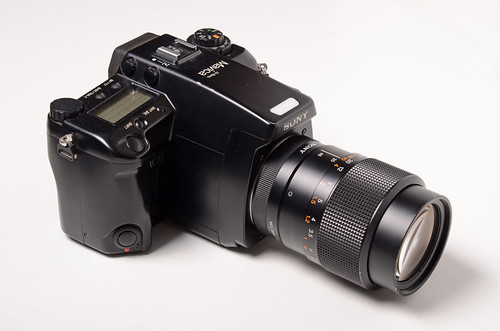
- 1989 — ProMavica MVC-5000 and MVC-7000 target professional markets.
- 1993 — Still-video format effectively discontinued.
1997–2002: The Digital Floppy Era
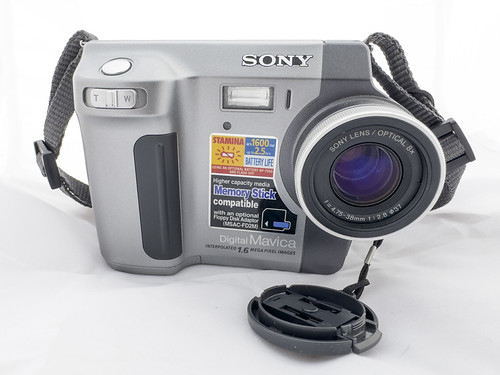
- 1997 — MVC-FD5 and FD7 launch as the first digital floppy Mavica cameras. A sensation: shoot and share photos with any PC's floppy drive.
- 1998 — FD51, FD71, FD81, FD91 expand the line with higher resolution and zoom options.
- 1999 — FD73, FD83, FD88 bring refinements and SteadyShot.
- 2000 — FD75, FD85, FD90, FD95 push resolution to 1.6 MP.
- 2001 — FD87, FD92, FD97 add Memory Stick dual-storage.
- 2002 — FD100 and FD200 are the final floppy models — budget cameras marking the end of an era.
2000–2003: The CD-R Era
- 2000 — CD1000 (MVC-CD1000) introduces 3" CD-R media. 2.1 MP resolution.
- 2001 — CD200, CD300 bring the format to consumers.
- 2002 — CD250, CD350, CD400 refine the concept.
- 2003 — CD500 is the final Mavica ever produced. 5.0 MP, 3x optical zoom, CD-R/RW storage.
Legacy
The Mavica name was retired after 2003 as Sony focused on the Cyber-shot line. But the Mavica's democratic approach to digital photography — no special software, no proprietary cables, just a standard disk — planted the seed for how we share images today.
Related Knowledge
The DKC Industrial Camera Series
Sony's DKC line was a family of industrial and professional digital cameras built for studio scanning, copy work, and high-resolution document capture — bridging still-video heritage with true digital output.
History & CultureStill-Video vs Digital
The fundamental technological shift from analog still-video capture to digital image files within the Mavica family.
History & CultureMavipack & Video Floppy
The analog still-video recording formats used by the original 1981-era Sony Mavica cameras before the digital era.
Storage & MediaThe ProMavica Line: MVC-2000, 5000 & 7000
Sony's professional still-video cameras — the ProMavica MVC-2000, MVC-5000, and MVC-7000 — were among the earliest attempts at professional electronic photography, bridging the gap between analogue video and true digital imaging.
History & CultureMavica Model Numbering: Decoding FD, CD, MVC & DKC
Sony used a systematic naming convention across the Mavica family — FD, CD, MVC, and DKC prefixes each denote a camera's storage format, era, and intended market. Here's how to read any Mavica model number.
History & CultureThe CD Mavica Series
A guide to Sony's CD Mavica line (2001–2003) — the seven models that replaced floppy disks with 8cm CD-R media and pushed the Mavica brand to its highest resolutions.
History & CultureThe Digital Floppy Camera Era
How Sony's radical decision to use floppy disks as camera storage created a cultural phenomenon from 1997 to 2002.
History & CultureY2K Aesthetic & the Mavica: Late-90s Nostalgia in Digital Form
The Y2K aesthetic — a design and cultural movement celebrating the visual language of 1997–2003 — has placed the Sony Mavica at its centre. Chunky silver electronics, pixelated images, floppy disks, and iMac-era optimism: the Mavica embodies the era.
History & CultureMavica in Pop Culture: Film, TV, Music & Art
The Sony Mavica has appeared in films, television shows, music videos, and contemporary art — sometimes as a plot device, sometimes as a visual prop, and increasingly as a deliberate artistic tool. This article catalogues the Mavica's cultural footprint.
History & Culture