Still-Video vs Digital
The fundamental technological shift from analog still-video capture to digital image files within the Mavica family.
Two completely different technologies
The name "Mavica" spans two fundamentally different camera technologies. Understanding the distinction is essential for collectors and historians.
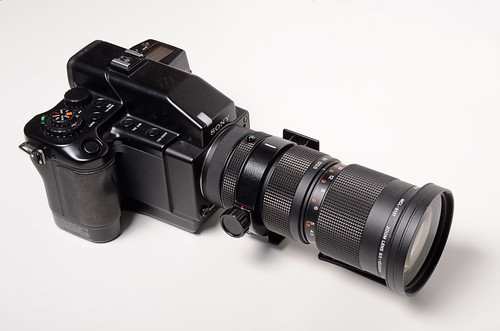
Analog still-video (1981–1993)
Still-video cameras capture a single frame of analog video signal and record it to a magnetic disk. The output is not a file — it's a continuous analog waveform:
- Capture — CCD sensor → analog video signal → magnetic recording
- Resolution — approximately 400 TV lines (~0.1 MP equivalent)
- Storage — Mavipack or Video Floppy (VF) magnetic disk, 25-50 frames
- Playback — requires a dedicated VF player connected to a TV, or a VF printer
- No computer interface — these are pre-digital devices
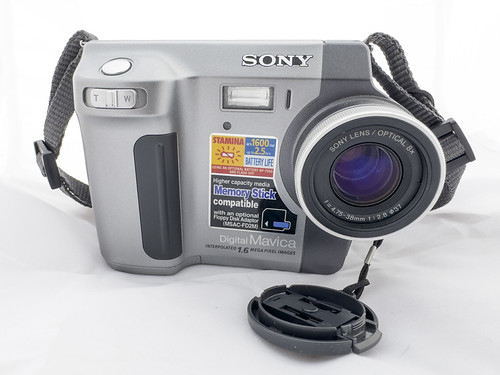
Digital Mavica (1997–2003)
Digital Mavica cameras capture a digital image, process it, compress it to JPEG, and write a standard file to removable media:
- Capture — CCD sensor → ADC → image processor → JPEG compression
- Resolution — 0.3 to 5.0 MP
- Storage — 3.5" floppy disk, Memory Stick, or 3" CD-R/RW
- Playback — any computer, any image viewer
- Standard files — JPEG images readable on any platform
Why the distinction matters
Collectors frequently confuse the two. A "Sony Mavica" from 1988 and one from 1998 share only a name — they are entirely different devices with incompatible media, incompatible outputs, and radically different capabilities.
Related Knowledge
The DKC Industrial Camera Series
Sony's DKC line was a family of industrial and professional digital cameras built for studio scanning, copy work, and high-resolution document capture — bridging still-video heritage with true digital output.
History & CultureMavipack & Video Floppy
The analog still-video recording formats used by the original 1981-era Sony Mavica cameras before the digital era.
Storage & MediaThe ProMavica Line: MVC-2000, 5000 & 7000
Sony's professional still-video cameras — the ProMavica MVC-2000, MVC-5000, and MVC-7000 — were among the earliest attempts at professional electronic photography, bridging the gap between analogue video and true digital imaging.
History & CultureMavica Model Numbering: Decoding FD, CD, MVC & DKC
Sony used a systematic naming convention across the Mavica family — FD, CD, MVC, and DKC prefixes each denote a camera's storage format, era, and intended market. Here's how to read any Mavica model number.
History & CultureCCD Sensors
The charge-coupled device (CCD) image sensor that defined the Mavica era — how it captures light and why it produces a distinct look.
Camera TechnologySony Mavica Timeline (1981–2003)
The complete chronological history of the Sony Mavica lineup — from the 1981 still-video prototype to the final CD-burning models.
History & Culture