CCD Sensors
The charge-coupled device (CCD) image sensor that defined the Mavica era — how it captures light and why it produces a distinct look.
What is a CCD sensor?
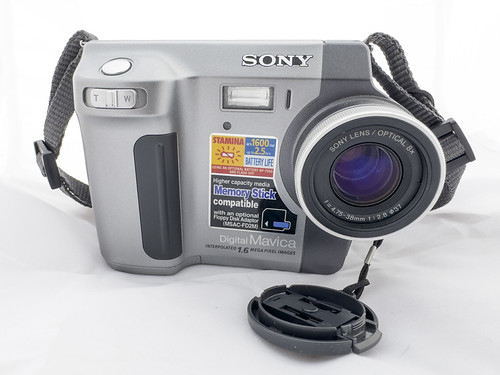
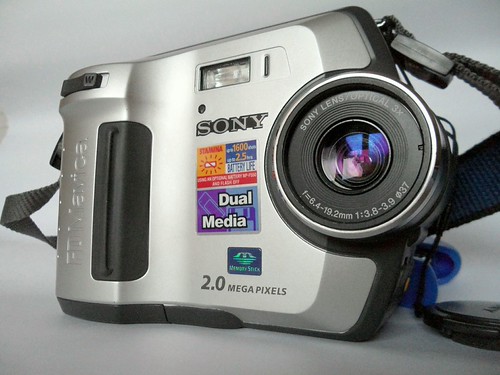
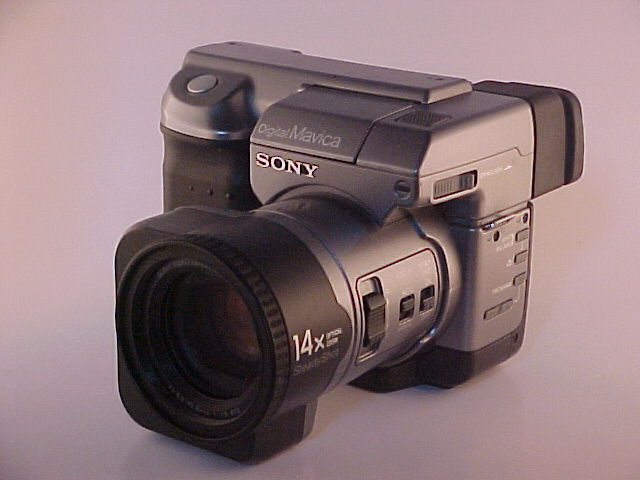
A charge-coupled device (CCD) is an analog shift register that converts photons into electrical charge packets. Every Sony Mavica digital camera used a CCD sensor — typically a 1/4" to 1/2.7" chip with between 0.3 and 3.3 effective megapixels.
How CCD differs from CMOS
Unlike modern CMOS sensors where each pixel has its own amplifier, CCD sensors shift charge row-by-row to a single output amplifier. This gives CCD images their characteristic uniform noise profile and smooth tonal gradations, but also makes them more power-hungry.
The Mavica CCD look
The combination of small CCD sensors, aggressive JPEG compression, and limited color depth gives Mavica photos their signature aesthetic: slightly soft detail, warm color casts, and visible compression artifacts. Many lo-fi photographers seek out exactly this imperfect quality.
Interlaced vs. progressive readout
Some Mavica models (notably the FD5 and FD51) use interlaced CCD readout, which captures odd and even rows in separate passes. This can produce subtle horizontal banding artifacts in high-contrast scenes — an effect some photographers deliberately exploit for creative purposes.
Key specifications by model
- 0.3 MP CCD — FD5, FD7, FD51, FD71, FD73, FD75
- 0.8 MP CCD — FD81, FD83
- 1.0 MP CCD — FD85, FD87, FD88, FD90
- 1.3 MP CCD — FD91, FD92, FD95, FD97
- 1.2 MP CCD — FD100, FD200
- 2.1–3.3 MP CCD — CD-series models
Related Knowledge
Hot Pixels & Fixed-Pattern Noise
Why aged CCD sensors develop stuck bright pixels and patterned noise — what causes it, which Mavica models are most affected, and how to manage it.
Camera TechnologyThe DKC Industrial Camera Series
Sony's DKC line was a family of industrial and professional digital cameras built for studio scanning, copy work, and high-resolution document capture — bridging still-video heritage with true digital output.
History & CultureSensor Sizes Explained
A guide to the fractional-inch sensor size notation (1/4", 1/3", 1/2.7", 1/1.8") used across the Mavica lineup and how it affects image quality.
Camera TechnologyCCD Bloom
A sensor overflow artifact where bright light bleeds into adjacent pixels, creating ethereal vertical streaks unique to CCD cameras.
Camera TechnologyStill-Video vs Digital
The fundamental technological shift from analog still-video capture to digital image files within the Mavica family.
History & CultureInterlaced vs Progressive Scan
How interlaced CCD readout works, which Mavica models use it, and the visual artifacts it produces compared to progressive-scan sensors.
Camera TechnologyJPEG Compression on Mavica
How the Mavica's aggressive JPEG compression shapes its distinctive image character — artifacts as aesthetic.
Storage & MediaThe ProMavica Line: MVC-2000, 5000 & 7000
Sony's professional still-video cameras — the ProMavica MVC-2000, MVC-5000, and MVC-7000 — were among the earliest attempts at professional electronic photography, bridging the gap between analogue video and true digital imaging.
History & CultureScanning with a Mavica: Using DKC Cameras as Digitisers
Sony's DKC industrial cameras were designed to act as high-quality digitisers — mounted on copy stands to capture documents, artwork, and flat media. This guide covers the technique, equipment, and workflow.
TechniquesCCD Degradation Over Time: Age-Related Sensor Decay
Mavica CCD sensors are 22–28 years old. Over decades, CCDs develop progressive degradation — increased noise, colour shifts, reduced sensitivity, and eventually complete failure. This article explains what happens, how to assess a sensor's condition, and what (if anything) can be done.
Repair & Restoration