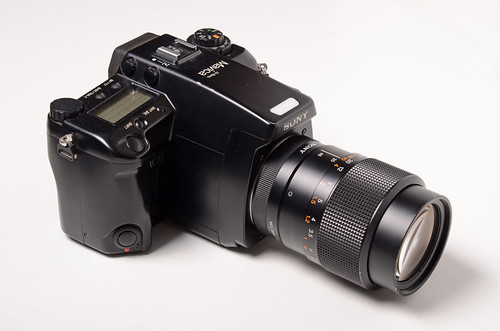
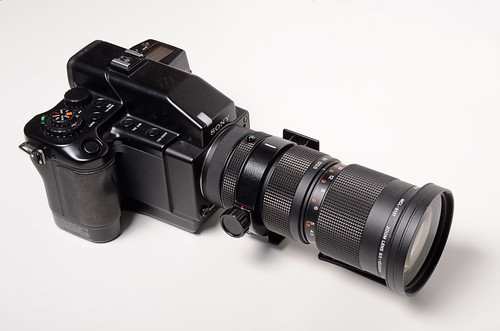
The ProMavica Line: MVC-2000, 5000 & 7000
Sony's professional still-video cameras — the ProMavica MVC-2000, MVC-5000, and MVC-7000 — were among the earliest attempts at professional electronic photography, bridging the gap between analogue video and true digital imaging.
What is the ProMavica?
The ProMavica line was Sony's professional-grade branch of the Mavica family, released between 1988 and 1991. While the consumer Mavica cameras were designed for casual photography, the ProMavica units targeted studios, press photographers, and scientific/industrial users who needed immediate electronic images without waiting for film processing.
All three ProMavica models record analogue still-video frames onto 2-inch Video Floppy disks (Mavipack format) — they are not digital cameras. They capture a single CCD frame and write it as an NTSC or PAL analogue video signal.
The three models
MVC-2000 (1988)
The entry point of the ProMavica line.
- Sensor: 2/3" CCD, approximately 380,000 pixels
- Lens: Interchangeable — used Sony α (A-mount) lenses
- Recording: Analogue still-video on 2" Video Floppy
- Output: NTSC composite video
- Viewfinder: Electronic viewfinder (EVF)
- Body style: SLR-shaped with vertical grip
The MVC-2000 was the first Mavica with interchangeable lenses, giving it legitimate professional flexibility. With an A-mount adapter, photographers could use the full Sony/Minolta lens ecosystem.
MVC-5000 (1989)
The mid-range professional model with improved resolution.
- Sensor: 2/3" CCD, approximately 460,000 pixels
- Lens: Interchangeable — Sony α (A-mount) lenses
- Recording: Analogue still-video, Field or Frame mode
- Output: NTSC/PAL composite and S-Video
- Viewfinder: EVF with exposure information overlay
- Body style: Similar to MVC-2000 but heavier build
The MVC-5000 introduced Frame mode recording, which captured both fields of an interlaced frame for higher vertical resolution. It also added S-Video output for cleaner signal transmission to monitors and printers.
MVC-7000 (1990)
The flagship ProMavica and the most capable still-video camera Sony ever produced.
- Sensor: 2/3" CCD, approximately 640,000 pixels
- Lens: Interchangeable — Sony α (A-mount) lenses
- Recording: Analogue still-video, 25 frames per disk
- Output: NTSC/PAL composite, S-Video, and RGB component
- Viewfinder: High-resolution EVF with histogram
- Body style: Larger, ruggedised professional body
- Special features: Interval recording, external flash sync, remote trigger
The MVC-7000 was the peak of still-video technology — released just as digital capture was beginning to make the format obsolete. Its RGB component output allowed direct connection to high-end video printers for publication-quality prints.
ProMavica in context
Who used them?
- News agencies: Reuters, AP, and UPI experimented with still-video for rapid image transmission. A ProMavica image could be sent over a phone line in seconds — versus hours for film that needed developing and scanning.
- Real estate: Instant electronic images for property listings.
- Medical and scientific imaging: The consistent, repeatable CCD output was useful for documentation.
- Pre-press proofing: Quick visual mockups before committing to film.
Why they didn't last
The ProMavica line was discontinued by 1992. Several factors contributed:
- Resolution: Even the MVC-7000's ~640K pixels couldn't compete with film. A 35mm negative resolves roughly 20 megapixels — the ProMavica was orders of magnitude behind.
- Analogue format: The still-video signal degraded with each copy. Digital files, by contrast, are lossless.
- Cost: ProMavica bodies were priced at $5,000–$15,000 USD. The MVC-7000 with lenses exceeded $20,000.
- Kodak DCS-100: In 1991, Kodak released the DCS-100 — a true 1.3 megapixel digital camera in a Nikon F3 body. It stored actual digital files and immediately made analogue still-video obsolete for professional use.
Legacy
Despite their commercial failure, the ProMavica cameras proved that electronic photography was viable for professional work. The lessons Sony learned about CCD sensor design, electronic viewfinders, and rapid image capture directly informed the consumer Mavica FD-series that launched in 1997 — cameras that would become iconic.
Collecting ProMavica today
ProMavica units are rare. Estimated survival rates are low because most were institutional purchases that were discarded when replaced.
| Model | Estimated surviving units | Typical market price |
|---|---|---|
| MVC-2000 | Very rare | $200–$600 |
| MVC-5000 | Rare | $300–$800 |
| MVC-7000 | Extremely rare | $500–$1,500+ |
Challenges for collectors:
- Mavipack disks are nearly impossible to find new. Seek NOS (new old stock) lots on auction sites.
- A-mount lenses are still plentiful (Minolta/Sony ecosystem), so lens availability is not a problem.
- Playback requires a Mavigraph printer or video capture device to view the analogue still-video frames.
- Battery packs are proprietary and likely dead — AC adapters are essential for actual use.
Related Knowledge
Mavica Lens Systems: Sony vs Carl Zeiss
A detailed comparison of the Sony-branded and Carl Zeiss Vario-Sonnar lenses used across the Mavica lineup — optical design, coatings, and real-world performance differences.
Camera TechnologyThe DKC Industrial Camera Series
Sony's DKC line was a family of industrial and professional digital cameras built for studio scanning, copy work, and high-resolution document capture — bridging still-video heritage with true digital output.
History & CultureStill-Video vs Digital
The fundamental technological shift from analog still-video capture to digital image files within the Mavica family.
History & CultureMavipack & Video Floppy
The analog still-video recording formats used by the original 1981-era Sony Mavica cameras before the digital era.
Storage & MediaMavica Model Numbering: Decoding FD, CD, MVC & DKC
Sony used a systematic naming convention across the Mavica family — FD, CD, MVC, and DKC prefixes each denote a camera's storage format, era, and intended market. Here's how to read any Mavica model number.
History & CultureCCD Sensors
The charge-coupled device (CCD) image sensor that defined the Mavica era — how it captures light and why it produces a distinct look.
Camera TechnologySony Mavica Timeline (1981–2003)
The complete chronological history of the Sony Mavica lineup — from the 1981 still-video prototype to the final CD-burning models.
History & Culture