Mavica Model Numbering: Decoding FD, CD, MVC & DKC
Sony used a systematic naming convention across the Mavica family — FD, CD, MVC, and DKC prefixes each denote a camera's storage format, era, and intended market. Here's how to read any Mavica model number.
The four Mavica prefixes
Every Mavica camera model number begins with a prefix that tells you two things: what era the camera is from and what storage medium it uses.
FD — Floppy Disk
Example models: FD5, FD7, FD51, FD71, FD73, FD75, FD81, FD83, FD85, FD87, FD88, FD90, FD91, FD92, FD95, FD97, FD100, FD200
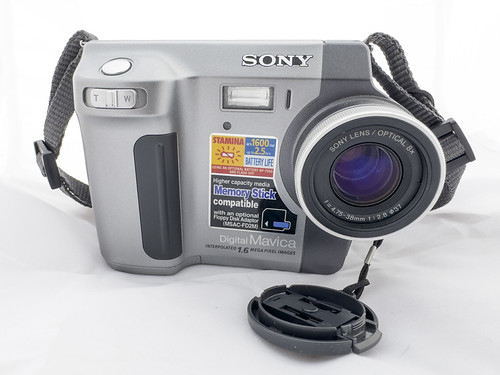
The FD prefix denotes the floppy disk Mavica series, produced from 1997 to 2002. These are the most iconic and widely recognised Mavica cameras — the ones that save photos directly to standard 3.5" HD floppy disks.
- FD5 / FD7: The original pair. FD5 was the entry-level (0.3 MP, no flash), FD7 added a flash and optical viewfinder.
- FD51 / FD71 / FD73 / FD75: Second generation with improved resolution and features.
- FD81 / FD83 / FD85 / FD87: Third generation. FD87 reached 1.2 MP.
- FD88 / FD90 / FD91 / FD92: The "FD-90 series" — peak floppy Mavica with FD91 offering image stabilisation and an EVF.
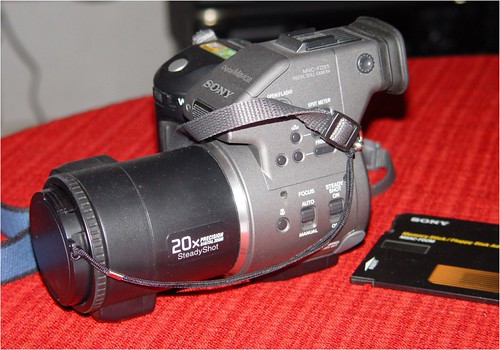
- FD95 / FD97: Final floppy models with 2.1 MP sensors, optical zoom up to 10×, and Memory Stick slots alongside floppy.
- FD100 / FD200: Last gasp of the FD line. FD200 was 1.3 MP with 3× zoom — a budget model.
General pattern: Higher numbers within a generation indicate more features. Odd numbers (FD5, FD7, FD51) were early; two-digit numbers mid-range; three-digit numbers (FD100, FD200) were late budget entries.
CD — Compact Disc
Example models: CD200, CD250, CD300, CD350, CD400, CD500, CD1000
The CD prefix denotes the CD Mavica series, produced from 2000 to 2003. These cameras record images onto 8cm CD-R or CD-RW mini discs, offering vastly more storage than floppy (156 MB vs 1.44 MB).
- CD200: Entry level, 2.1 MP
- CD250 / CD300 / CD350: Mid-range with 3.3 MP
- CD400: Compact design, 2.1 MP
- CD500: The popular enthusiast model — 5.0 MP with Carl Zeiss lens
- CD1000: The flagship — 5.0 MP, 10× Carl Zeiss zoom, image stabilisation
Pattern: Numbers roughly correspond to feature level. The CD1000 designation explicitly signals "top of the line."
MVC — Mavica Video Camera
Example models: MVC-A10, MVC-A7AF, MVC-C1, MVC-2000, MVC-5000, MVC-7000
The MVC prefix is the original Mavica designation and covers two distinct eras:
Still-video era (1981–1993):
- MVC-2000 / MVC-5000 / MVC-7000: The ProMavica professional line. Analogue still-video cameras recording onto 2" Video Floppy disks with A-mount interchangeable lenses.
Transition era (1996–1998):
- MVC-A10: The original 1981 prototype designation recycled for an early Memory Stick model.
- MVC-A7AF: Early still-video Mavica with autofocus.
- MVC-C1: A compact Memory Stick Mavica — technically a Cyber-shot precursor.
The MVC prefix was retired for consumer cameras as the FD/CD naming took over, but it lived on briefly in mixed-format models.
DKC — Digital Camera (Industrial)
Example models: DKC-C100X, DKC-C200X, DKC-C2050X, DKC-C21X, DKC-C300X, DKC-CM30, DKC-ID1
The DKC prefix denotes Sony's industrial and professional digital camera line, produced from approximately 1994 to 2000. These were not consumer products — they were sold through professional/industrial channels for:
- Studio copy work and art digitisation
- Scientific and medical imaging
- ID badge / access card photography
Sub-numbering:
- C = Camera (general), CM = Camera/Monitor (video capable), ID = Identification
- X suffix indicates a later revision (e.g., C200X superseded C200)
- Higher C-numbers indicate higher resolution/capability
The numbering logic
Generation indicators
Within the FD line, Sony used a rough pattern:
| Number Range | Generation | Era |
|---|---|---|
| 5–7 | 1st gen | 1997 |
| 51–75 | 2nd gen | 1998–1999 |
| 81–87 | 3rd gen | 1999–2000 |
| 88–97 | 4th gen | 2000–2001 |
| 100–200 | 5th gen (budget) | 2001–2002 |
Feature tier indicators
Within a generation, higher numbers usually mean more features:
- FD71 (basic) → FD73 (with multi-burst) → FD75 (with more zoom)
- FD81 (basic) → FD85 (more zoom) → FD87 (highest resolution)
- CD200 (entry) → CD300 (mid) → CD500 (advanced) → CD1000 (flagship)
Exceptions
- FD88: Sits between 3rd gen and 4th gen — it was a Japanese-market transitional model.
- FD92: A cost-reduced variant of the FD91, dropping image stabilisation.
- CD250 / CD350: Minor mid-cycle refreshes of the CD200 and CD300 respectively.
Quick reference table
| Prefix | Storage | Era | Market | Models in MaviCats Gearbase |
|---|---|---|---|---|
| MVC | Video Floppy / Memory Stick | 1981–1998 | Pro & consumer | 6 |
| DKC | SCSI / FireWire / USB | 1994–2000 | Industrial | 7 |
| FD | 3.5" Floppy Disk | 1997–2002 | Consumer | 18 |
| CD | 8cm Mini CD-R/RW | 2000–2003 | Consumer | 7 |
Why it matters
Understanding the model number lets you instantly know:
- What media you need — floppy disks, CD-Rs, Video Floppies, or a SCSI cable
- What era of technology to expect — resolution, features, lens quality
- Where the camera sits in the lineup — budget entry, mid-range, or flagship
- Approximate market value — higher-tier models within each prefix command higher prices
Related Knowledge
Mavica Storage Evolution: Floppy → Memory Stick → CD
How Mavica storage evolved across three decades — from analog video floppy to 1.44 MB diskette to Memory Stick to 156 MB CD-R — and the tradeoffs at each stage.
Storage & MediaThe DKC Industrial Camera Series
Sony's DKC line was a family of industrial and professional digital cameras built for studio scanning, copy work, and high-resolution document capture — bridging still-video heritage with true digital output.
History & CultureStill-Video vs Digital
The fundamental technological shift from analog still-video capture to digital image files within the Mavica family.
History & CultureThe ProMavica Line: MVC-2000, 5000 & 7000
Sony's professional still-video cameras — the ProMavica MVC-2000, MVC-5000, and MVC-7000 — were among the earliest attempts at professional electronic photography, bridging the gap between analogue video and true digital imaging.
History & CultureThe CD Mavica Series
A guide to Sony's CD Mavica line (2001–2003) — the seven models that replaced floppy disks with 8cm CD-R media and pushed the Mavica brand to its highest resolutions.
History & CultureThe Digital Floppy Camera Era
How Sony's radical decision to use floppy disks as camera storage created a cultural phenomenon from 1997 to 2002.
History & CultureSony Mavica Timeline (1981–2003)
The complete chronological history of the Sony Mavica lineup — from the 1981 still-video prototype to the final CD-burning models.
History & Culture