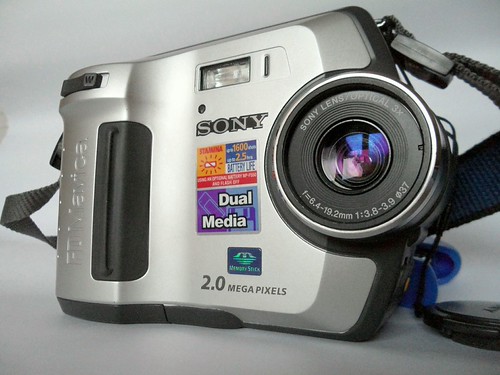
The Digital Floppy Camera Era
How Sony's radical decision to use floppy disks as camera storage created a cultural phenomenon from 1997 to 2002.
A radical idea
In 1997, sharing digital photos required proprietary cables, driver software, and often patience. Sony's idea was brilliantly simple: use the 3.5" floppy disk — already in every computer on Earth — as the camera's storage medium.
Why it worked
- Zero friction — no drivers, no cables, no card readers
- Universal compatibility — every PC and Mac had a floppy drive
- Instant sharing — hand someone a disk and they have your photos
- Affordable media — floppy disks cost pennies
Market success
The Mavica FD7 became one of the best-selling digital cameras of 1997-1998. Schools, real estate agents, and families adopted it because the workflow was so simple. At a time when most people had never transferred a photo to a computer, the Mavica made it trivial.
The inevitable decline
By 2001, several factors conspired against floppy storage:
- CompactFlash and SmartMedia cards offered 64-256 MB
- USB connectivity became standard
- Camera resolutions exceeded what a floppy could store
- Apple removed the floppy drive from the iMac (1998), starting the trend
Cultural impact
The Mavica proved that ease of sharing matters more than image quality. This insight — that the best camera is the one that gets your photos where they need to go — anticipated the smartphone photography revolution by a decade.
Related Knowledge
The Retro-Tech Revival
How and why a new generation of photographers is rediscovering vintage digital cameras as creative tools.
History & Culture3.5" Floppy Disk Photography
How Sony Mavica cameras used standard 1.44 MB floppy disks as their primary storage medium — constraints, workflow, and charm.
Storage & MediaMavica Model Numbering: Decoding FD, CD, MVC & DKC
Sony used a systematic naming convention across the Mavica family — FD, CD, MVC, and DKC prefixes each denote a camera's storage format, era, and intended market. Here's how to read any Mavica model number.
History & CultureThe CD Mavica Series
A guide to Sony's CD Mavica line (2001–2003) — the seven models that replaced floppy disks with 8cm CD-R media and pushed the Mavica brand to its highest resolutions.
History & CultureY2K Aesthetic & the Mavica: Late-90s Nostalgia in Digital Form
The Y2K aesthetic — a design and cultural movement celebrating the visual language of 1997–2003 — has placed the Sony Mavica at its centre. Chunky silver electronics, pixelated images, floppy disks, and iMac-era optimism: the Mavica embodies the era.
History & CultureSony Mavica Timeline (1981–2003)
The complete chronological history of the Sony Mavica lineup — from the 1981 still-video prototype to the final CD-burning models.
History & Culture