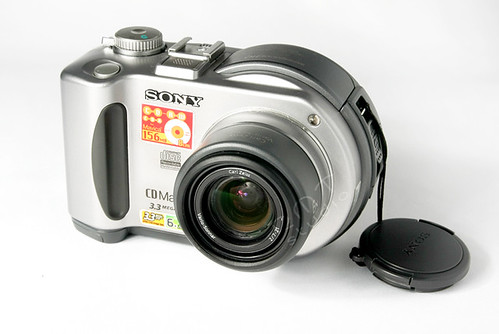
Mavica Lens Systems: Sony vs Carl Zeiss
A detailed comparison of the Sony-branded and Carl Zeiss Vario-Sonnar lenses used across the Mavica lineup — optical design, coatings, and real-world performance differences.
Two lens families
The Mavica line used two distinct lens families:
- Sony-branded lenses — used on all floppy models and the budget CD cameras
- Carl Zeiss Vario-Sonnar lenses — used on the premium CD-series models (CD300, CD400, CD500)
Both are fixed (non-interchangeable) zoom lenses built into the camera body. The optical designs were developed specifically for each camera's sensor size and intended price point.
Sony-branded Mavica lenses
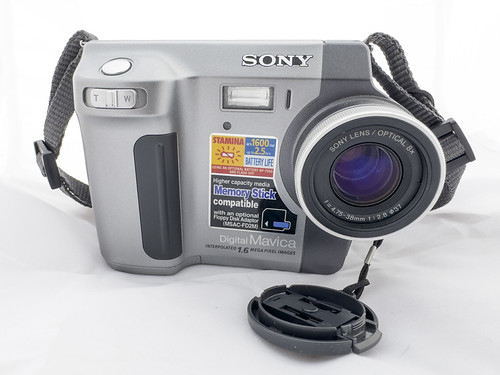
3× zoom (f/2.0)
Used on: FD81, FD83, FD85, FD87, FD100, FD200, CD200, CD250, CD350
This is the workhorse Mavica lens. A compact 3× zoom with a bright f/2.0 maximum aperture at the wide end. The optical formula uses 6 elements in 5 groups — a simple but effective design for the small CCD sensors.
Characteristics:
- Good centre sharpness, softer corners
- Moderate barrel distortion at wide angle (~2%)
- Visible chromatic aberration (purple fringing) at high-contrast edges
- Adequate flare resistance for casual shooting
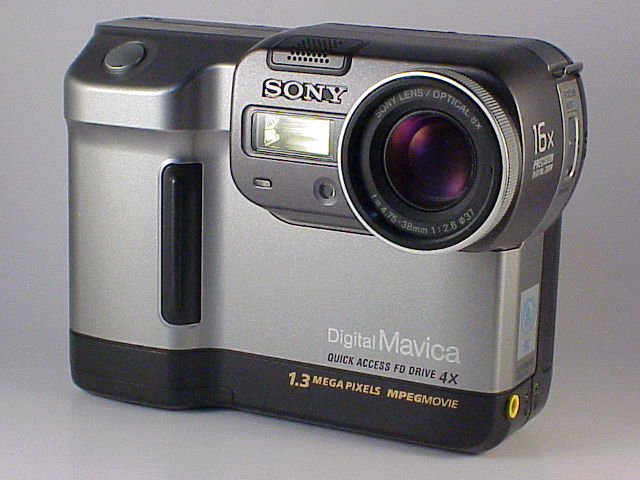
10× zoom (f/2.8)
Used on: FD7, FD71, FD73, FD75, FD95, FD97, CD1000
A more complex design with 11 elements in 9 groups, accommodating the 10× zoom range. The f/2.8 maximum aperture is one stop slower than the 3× lenses.
Characteristics:
- Impressive zoom range in a compact body
- Sharpness drops noticeably above 7× zoom
- Stronger chromatic aberration than the 3× design
- Internal focusing (lens barrel doesn't extend during focus, only during zoom)
8× zoom (f/1.8)
Used on: FD88, FD90, FD92
The fastest lens in the Mavica lineup. Its f/1.8 maximum aperture provides the best low-light performance of any Mavica lens. The optical formula uses 10 elements in 8 groups.
Characteristics:
- Excellent low-light capability
- Good sharpness from wide to ~5× zoom
- Some softness at f/1.8 wide open (improves at f/2.8)
- The FD90's 3.5" LCD makes the most of this lens's detail
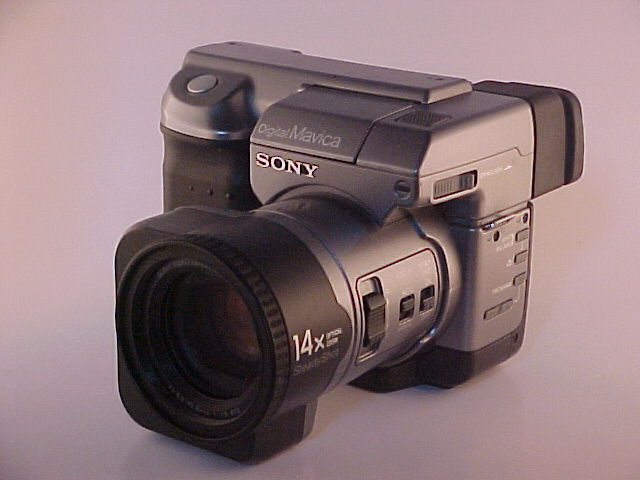
14× zoom (f/3.8)
Used on: FD91
The longest zoom of any Mavica — 37–518 mm equivalent. The 14 elements in 10 groups design prioritised zoom range over maximum aperture. At f/3.8, this is the slowest Mavica lens.
Characteristics:
- Extreme reach for a compact camera
- Requires SteadyShot and bright light at the tele end
- Measurably softer than shorter zooms, especially above 10×
- Most effective for telephoto snapshot-style shooting rather than fine detail
Carl Zeiss Vario-Sonnar lenses
Used on: CD300, CD400, CD500
The Vario-Sonnar is a premium lens design from Carl Zeiss, licensed by Sony for their higher-end digital cameras. The Mavica versions use 7 elements in 6 groups with a 3× zoom range and f/2.8 maximum aperture.
Design differences from Sony lenses
- T lens coating**: Carl Zeiss's proprietary multi-layer anti-reflective coating reduces flare and ghosting significantly. In backlit shooting the Zeiss lenses produce cleaner images with less veiling flare.
- Higher optical resolution: Bench-tested at approximately 40% more line pairs per millimeter at the centre compared to the Sony 3× design. In practice this means visibly sharper detail, especially at the 3–5 MP resolution of the CD300/400/500.
- Better edge performance: The Zeiss designs maintain sharpness closer to the frame corners, reducing the "sharp centre, soft edges" pattern of the Sony lenses.
- Lower distortion: Barrel distortion at the wide end is roughly 1% vs 2% on the Sony 3× lenses.
Real-world impact
At the resolutions involved (2–5 MP), the Zeiss lens advantage is visible in:
- Fine text and patterns (brick walls, foliage)
- High-contrast edges (less purple fringing)
- Backlit scenes (less flare wash)
For casual, lo-fi shooting, the difference is subtle. For anyone pushing Mavica image quality to its limits, the CD300/400/500 with Zeiss glass produce measurably superior results.
Lens comparison table
| Lens | Zoom | Max Aperture | Elements/Groups | Coating | Models |
|---|---|---|---|---|---|
| Sony 3× | 3× | f/2.0 | 6/5 | Standard multi-coat | FD81–FD200, CD200, CD250, CD350 |
| Sony 10× | 10× | f/2.8 | 11/9 | Standard multi-coat | FD7–FD97, CD1000 |
| Sony 8× | 8× | f/1.8 | 10/8 | Standard multi-coat | FD88, FD90, FD92 |
| Sony 14× | 14× | f/3.8 | 14/10 | Standard multi-coat | FD91 |
| Zeiss Vario-Sonnar 3× | 3× | f/2.8 | 7/6 | T* multi-coat | CD300, CD400, CD500 |
Fixed-focus lenses
The FD5 and FD51 use a fundamentally different lens: a simple fixed-focus, fixed-focal-length design with no zoom and no focus mechanism. It's a 2-element lens optimised for the tiny 1/4" sensor. Surprisingly sharp at the centre for its simplicity, though edge quality is poor.
Practical advice
- For maximum image quality: CD500 (Zeiss + 5 MP) or CD400 (Zeiss + 4 MP)
- For best low-light: FD88 or FD90 (f/1.8)
- For maximum zoom reach: FD91 (14×) or FD95/FD97 (10×)
- For lo-fi character: FD5 or FD7 (lens imperfections add to the charm)
- All Mavica lenses are non-replaceable — if the lens mechanism fails, the camera needs a full lens assembly replacement or becomes a parts donor.
Related Knowledge
Filter Threads & Lens Accessories
Which Mavica models have filter threads, what sizes they use, and what photographic filters and conversion lenses you can attach.
Camera TechnologyLens Barrel Repair: Stuck Zoom & Focus Mechanisms
Stuck, grinding, or jammed zoom and focus mechanisms are among the most common mechanical failures on Mavica cameras. This guide covers diagnosis, common causes, and repair techniques for the lens barrel assembly.
Repair & RestorationAperture & F-Stops
Understanding the f-stop numbers listed for every Mavica lens — what they mean for exposure, depth of field, and low-light performance.
Camera TechnologyFocal Length & 35 mm Equivalent
What 35 mm equivalent focal length means, why it exists, and how to interpret the numbers shown for every Mavica in the Gearbase.
Camera TechnologyThe ProMavica Line: MVC-2000, 5000 & 7000
Sony's professional still-video cameras — the ProMavica MVC-2000, MVC-5000, and MVC-7000 — were among the earliest attempts at professional electronic photography, bridging the gap between analogue video and true digital imaging.
History & CultureScanning with a Mavica: Using DKC Cameras as Digitisers
Sony's DKC industrial cameras were designed to act as high-quality digitisers — mounted on copy stands to capture documents, artwork, and flat media. This guide covers the technique, equipment, and workflow.
Techniques