Aperture & F-Stops
Understanding the f-stop numbers listed for every Mavica lens — what they mean for exposure, depth of field, and low-light performance.
What is aperture?
The aperture is the adjustable opening inside the lens that controls how much light reaches the sensor. It's measured in f-stops — a ratio of the lens's focal length to the diameter of the opening.
Key principle: A smaller f-number means a larger opening, which lets in more light.
- f/1.8 — very wide open (lots of light)
- f/2.8 — moderately wide
- f/8.0 — moderately narrow
- f/16 — very narrow (little light)
Mavica aperture ranges
| Max Aperture | Models | Notes |
|---|---|---|
| f/1.8 | FD88, FD90, FD92 | Fastest Mavica lenses |
| f/2.0 | FD5, FD51, FD81, FD83, FD85, FD87, FD100, FD200 | Standard for 3× zoom models |
| f/2.8 | FD7, FD71, FD73, FD75, FD95, FD97 | Typical for 10× zoom lenses |
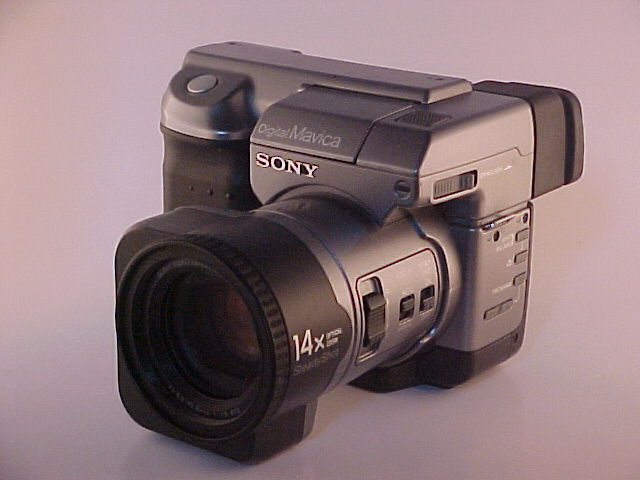
| f/3.8 | FD91 | Tradeoff for the 14× zoom range |
Most Mavica zoom lenses have a variable aperture — the maximum aperture narrows as you zoom in. For example, the FD90's lens is f/1.8 at wide angle but f/2.9 at full 8× zoom.
Why aperture matters on a Mavica
Low-light performance
Mavica CCDs have low sensitivity (roughly ISO 100 equivalent). A faster lens like f/1.8 lets in about 2.4× more light than f/2.8, which directly translates to faster shutter speeds and fewer blurry shots in dim conditions.
Depth of field
On Mavica sensors, depth of field is already very deep due to the small sensor sizes. Even at f/1.8 on a 1/2.7" sensor, background blur is minimal compared to a modern full-frame camera. At f/2.8 or smaller, nearly everything in the frame will be sharp.
Diffraction limit
Very small apertures (f/8 and above) cause diffraction, which softens the image. On a tiny CCD sensor, the diffraction limit kicks in earlier than on larger sensors. Most Mavica images are sharpest between f/2.8 and f/5.6.
Program AE and aperture
On models with only "Auto" or "Program AE" exposure modes, you cannot directly control the aperture — the camera chooses for you. Only the higher-end models (FD88, FD90, FD91, FD92, FD95, FD97, CD-series with A/M modes) allow aperture-priority or manual aperture selection.
Fixed aperture vs fixed-focus
Don't confuse these: the FD5 and FD51 have a fixed-focus lens (no zoom, no focus ring) but the aperture is still adjustable by the camera's autoexposure system. "Fixed aperture" would mean the opening doesn't change — that's not the case on any Mavica.
Related Knowledge
Exposure Modes Explained
A walkthrough of Auto, Program AE, Shutter Priority (S), Aperture Priority (A), and Manual (M) exposure modes available on Mavica cameras.
Camera TechnologyFilter Threads & Lens Accessories
Which Mavica models have filter threads, what sizes they use, and what photographic filters and conversion lenses you can attach.
Camera TechnologyMavica Lens Systems: Sony vs Carl Zeiss
A detailed comparison of the Sony-branded and Carl Zeiss Vario-Sonnar lenses used across the Mavica lineup — optical design, coatings, and real-world performance differences.
Camera TechnologySensor Sizes Explained
A guide to the fractional-inch sensor size notation (1/4", 1/3", 1/2.7", 1/1.8") used across the Mavica lineup and how it affects image quality.
Camera TechnologyFocal Length & 35 mm Equivalent
What 35 mm equivalent focal length means, why it exists, and how to interpret the numbers shown for every Mavica in the Gearbase.
Camera Technology