Focal Length & 35 mm Equivalent
What 35 mm equivalent focal length means, why it exists, and how to interpret the numbers shown for every Mavica in the Gearbase.
Why "35 mm equivalent"?
Mavica cameras have tiny sensors compared to 35 mm film. A 5 mm lens on a Mavica captures a very different field of view than a 5 mm lens on a film camera. To make focal lengths comparable across different sensor sizes, manufacturers convert to "35 mm equivalent" — the focal length that would give the same field of view on a 35 mm film frame.
The conversion
35 mm equivalent = actual focal length × crop factor
The crop factor depends on sensor size:
| Sensor Size | Crop Factor | Example |
|---|---|---|
| 1/4" | ~9.6× | 4.9 mm actual → 47 mm equiv. |
| 1/3" | ~7.2× | 4.2–42 mm actual → 30–302 mm equiv. |
| 1/2.7" | ~6.5× | 5.4–43.2 mm actual → 35–281 mm equiv. |
| 1/1.8" | ~4.8× | 7.1–71 mm actual → 34–341 mm equiv. |
What focal lengths mean in practice
| 35 mm Equiv. | Field of View | Use Case |
|---|---|---|
| 34–40 mm | Moderate wide-angle | General-purpose, street shooting |
| 40–80 mm | Normal to short tele | Portraits, mid-range subjects |
| 80–200 mm | Telephoto | Sports, wildlife, distant subjects |
| 200–518 mm | Super-telephoto | Extreme reach (FD91's 14× zoom) |
Mavica focal length ranges
| Model | 35 mm Equiv. | Zoom Type |
|---|---|---|
| FD5, FD51 | 47 mm (fixed) | No zoom, fixed focus |
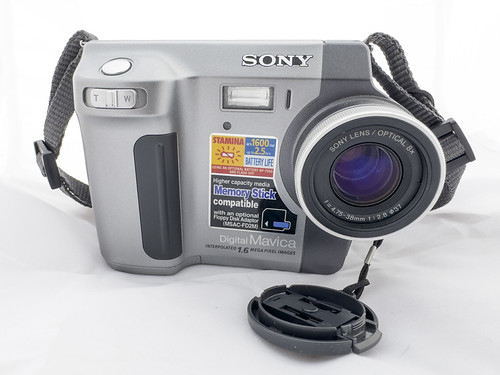
| FD81, FD83, FD85, FD87, FD100, FD200 | 39–117 mm | 3× optical |
| FD88, FD90, FD92 | 37–370 mm | 8× optical |
| FD7, FD71, FD73, FD75, FD95, FD97 | 40–400 mm | 10× optical |
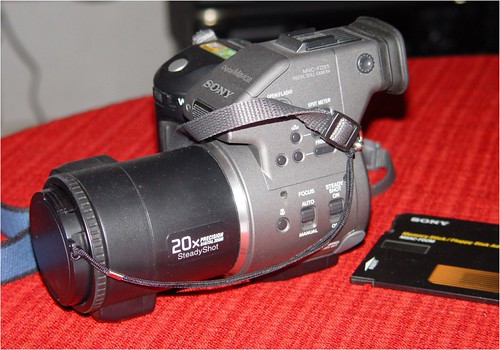
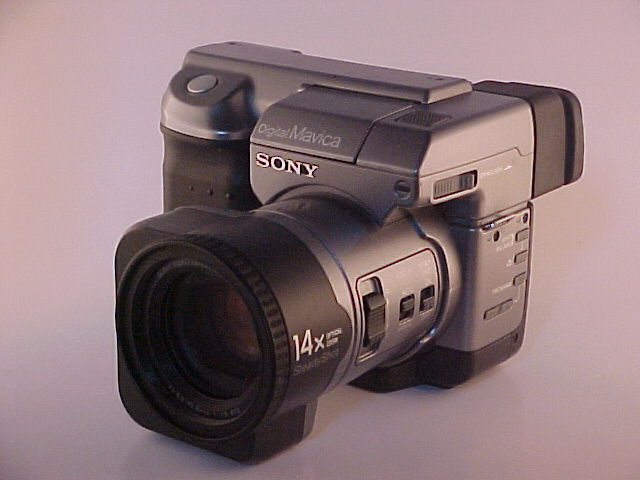
| FD91 | 37–518 mm | 14× optical |
| CD200, CD250 | 39–117 mm | 3× optical |
| CD300, CD350, CD400, CD500 | 34–102 mm | 3× optical |
| CD1000 | 37–370 mm | 10× optical |
Fixed-focus models
The FD5 and FD51 have a fixed 47 mm equivalent lens with no zoom or focus adjustment. Everything from about 1 metre to infinity is in focus (thanks to the tiny 1/4" sensor's deep depth of field). This makes them true point-and-shoot cameras but limits their versatility.
Practical tips
- Wide end (34–40 mm): Best for landscapes, interiors, and group shots. Most Mavica distortion occurs at the wide end.
- Tele end: Useful for isolating subjects, but requires SteadyShot or a tripod on the 8×+ zoom models.
- The FD91's 518 mm end is extreme — even with SteadyShot, you'll want bright light or a tripod.
Related Knowledge
Sensor Sizes Explained
A guide to the fractional-inch sensor size notation (1/4", 1/3", 1/2.7", 1/1.8") used across the Mavica lineup and how it affects image quality.
Camera TechnologyAperture & F-Stops
Understanding the f-stop numbers listed for every Mavica lens — what they mean for exposure, depth of field, and low-light performance.
Camera TechnologyOptical Zoom vs Digital Zoom
Understanding the difference between optical magnification (real lens movement) and digital zoom (software crop) across the Mavica lineup.
Camera TechnologyStitching & Panoramas: Working Around Low Resolution
Mavica cameras top out at 5 megapixels — and most shoot at well under 2 MP. Image stitching lets you combine multiple overlapping frames into a single high-resolution panorama, dramatically exceeding a single frame's detail.
Techniques